Context
Over time, I've realized that one of my most portable strengths is not tied to a single discipline. It shows up in operations, learning design, media, and product work in much the same way.
I notice friction quickly. Usually it is a repetitive task, a clumsy handoff, a tool gap, or an experience that feels far more cumbersome than it should. My instinct is to imagine what the smoother version would look like, build a first working prototype very quickly, and then iterate until it actually solves the problem.
If an organization hired me specifically for this strength, the role would be something like an operations optimization architect: someone who can enter a system, identify the friction points, and design practical, working solutions fast enough that the business feels the improvement almost immediately.
That pattern became especially clear to me after reading Philippa Hardman's work on the "full-stack learning designer". What resonated was not just the combination of design, coding, and project skills, but the underlying capacities: vision, empathy, communication, creativity, and judgment. Those are the things I rely on most. The tooling matters because it lets me execute, but the deeper skill is seeing how something could work better and then making that future state real.
If I had to name the identity beneath all of this, it would be simple: I am an optimizer.
The Mental Model
The best shorthand for how my mind works is the old XKCD comic about automation and saved time: if a task is frequent and repetitive enough, even a small improvement compounds into a huge gain over time.
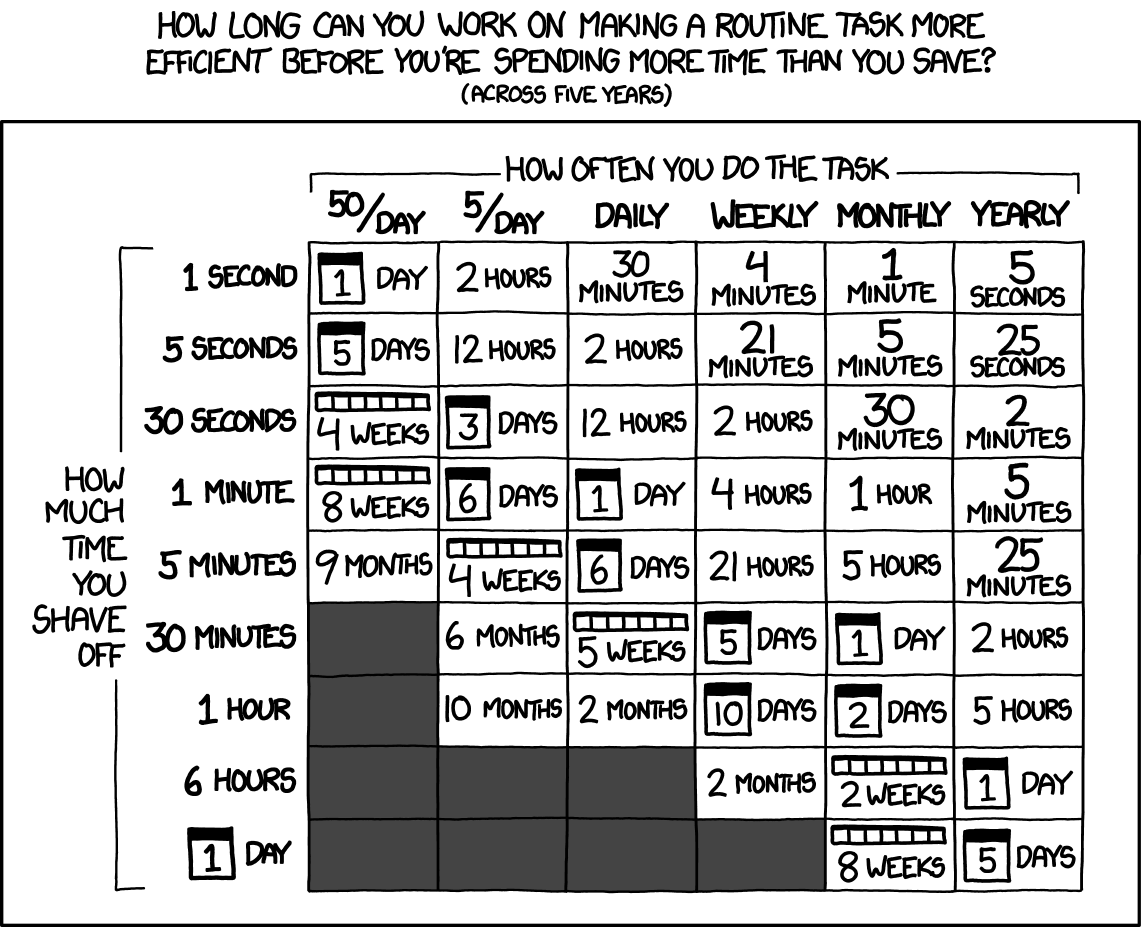
The XKCD comic sums it up well. I am always asking myself, "Is it worth the time?" For example, if I could build a tool to automate a process that currently takes 5 minutes, but that I currently spend 15 minutes doing, then I would say that it is absolutely worth the time.
I do not usually calculate that explicitly. It sits in the background. When I run into a workflow that feels wasteful, I instinctively ask two questions: why is this taking so long, and what would the smooth version feel like?
That means I tend to evaluate problems less as isolated annoyances and more as systems with hidden drag. The opportunity is often not in working harder, but in redesigning the process so the friction is removed altogether.
How I Build
My build process is consistent across very different kinds of work.
I start by picturing the ideal user experience. I think first about inputs, outputs, choices, and handoffs — not about code. I want to know what the person using the system should be able to do, what decisions they need to make, and what a clean experience would feel like.
From there, I prototype fast. With AI-assisted coding, I can usually get to a first working prototype in one or two hours. Most complete builds land somewhere between five and thirty hours, depending on complexity. My typical mode is simple UI first, just enough backend or logic to prove the flow works, then refinement and iteration until the system feels right.
Picture the ideal experience
Inputs, outputs, choices, handoffs — what should the user be able to do?
Prototype fast
First working version in 1–2 hours. Simple UI first, just enough logic to prove the flow.
Refine until it disappears
Iterate until the system feels natural enough that the user focuses on the task, not the tool.
I work primarily with ChatGPT and Claude. Lovable is often my fastest route to a full-stack build, especially when I need to scaffold an interface and the basic application logic quickly. Where AI tools stop helping is usually in infrastructure and integration work: configuring APIs, setting up services like Railway, wiring authentication, or debugging live failures. That is where I step in manually, reading logs, tracing errors, adjusting Python or JavaScript, and using the model as a debugging partner until the system behaves.
So AI has done two things for me at once. It has expanded what I can execute without being a formal software engineer, and it has dramatically accelerated a behavior I already had: iterative problem solving through making.
What This Looks Like in Practice
The clearest proof of this pattern is that it keeps appearing in very different contexts.Job Search Agent
~4 hoursTired of the manual overhead of reviewing LinkedIn job emails, I built a Python script connected to the Claude API. It pulls job URLs from Gmail-filtered alerts, scans and normalizes listings, evaluates each role against my rubric, stores results in a database, and generates an HTML review page with fit ratings and application tracking.
Processes ~10 roles/day, saves 30+ minutes daily, shifts work from triage to decision-making.
Learning Design Transformer
~3 hoursPaid consultingA freelance learning designer needed to transform textbook-style content into Canvas-ready courses. Manual conversion took 3–4 hours per module. I built two Claude-based artifacts: one to convert source material into the correct storyboard format, another to produce pedagogically sound Canvas HTML with accordions, expanders, tables, image suggestions, and text treatments.
Used across 45 modules. Turned hours of manual work per module into minutes.
TTRPG Audio Platform
~30 hoursRunning tabletop RPGs required five separate tools for immersive audio: Spotify, VLC, Audio Hijack, OBS, and a loop app, with players on a Twitch stream. I built a web app consolidating everything into one interface: music playlists, looping ambience, sound-effect trigger pads, independent mixing, and Discord bot integration via Railway.
Now includes user accounts, a free tier, subscription path, and active beta testers. Personal frustration → end-to-end product.
Plant Care App
~10 hoursBuilt to solve a personal problem: forgetting to water plants. Tracks watering history, sends reminders, and uses AI to populate care guidance including watering cadence and placement advice.
Other people installed it and thanked me for solving the problem for them.
AI NPC World
ExperimentalA persistent world where each player gets a procedurally generated map and NPCs with personalities, memory, and conversation histories powered by an LLM. Players can return days later and be remembered by characters they met before.
Demonstrates the same build pattern in an experimental, playful context.
Sigil Puzzle Game
~3 hoursA procedurally generated puzzle board for tabletop campaigns. A game master configures size and difficulty, receives a code, and gives it to players who see only the puzzle itself.
End-to-end build in ~3 hours: idea → interaction design → working system.
Crypto Arbitrage Monitor
~8 hoursNoticed that the USD/ZAR pair on Binance would occasionally dislocate sharply, creating a brief arbitrage loop between Binance and Valr. Built a tool that monitored both exchanges via API, calculated whether the spread cleared fees, and validated the opportunity in real time.
Enabled 60+ trades across a small number of event windows, generating substantial returns. Automated the monitoring; kept manual execution for authentication-complex trade loops.
What Connects All of These
At first glance, these projects look unrelated. Job search automation, learning design transformations, role-playing game tools, plant care reminders, arbitrage monitors, AI worlds. But they all come from the same operating principle.
I look for repeated friction. I find the leverage point. I automate or structure the parts that do not require human judgment. Then I refine the experience until the tool feels natural enough that the user can focus on the real task instead of the process around it.
That matters because many organizations are full of exactly this kind of hidden drag. People spend hours on formatting, routing, monitoring, triaging, copying, checking, and translating. Good people end up doing low-value repetitive work because no one has stepped back to redesign the system. What I do naturally is step into that gap.
Why This Matters Professionally
The value here is not that I can "code," at least not in the conventional sense. I am not a traditional software engineer, and I do not need to be. The value is that I can move from problem identification to working solution quickly by combining process thinking, UX judgment, light technical fluency, AI tooling, and iterative experimentation.
In professional settings, that shows up as workflow redesign, automation, content transformation, better tooling, lower manual overhead, and more time for real thinking. It is as relevant in operations as it is in learning design. In both cases, the goal is the same: get people out of repetitive admin and into the work that actually requires their brains.
Working Principle
I do not build for novelty. I build when repeated friction makes the cost of not building obvious.
The pattern is always the same: see the drag, imagine the better version, get to a prototype quickly, and keep refining until the system makes the work lighter.